I’m sure you’ve heard about the deadly stampede in Phnom Penh a week ago that killed at least 350 festival-goers, mostly women and young people, and left hundreds more injured. Although I’ve been to Phnom Penh many times, I was in my rural village at the time and did not know any of the victims,
But I saw the striking way Cambodians deal with grief on a national scale. I also saw the way news travels in a developing country, where BlackBerrys are unheard of and most people have never used the internet.
The stampede occurred on a bridge during the annual Water Festival. During Water Festival, about two million people from the countryside flock to Phnom Penh, doubling the population. There are so many crowds it’s difficult to go anywhere or see the boats, the main attraction of the festival. The Cambodian heat (where temperatures typically reach 95-100 degrees), while being surrounded by slow-moving people, along with tons of traffic to get into Phnom Penh, did not appeal to me.
Therefore, I was in my rural village the day of the tragedy. The day we heard about the tragedy was typical. Cambodians watched the news a little more, but basically carried on with their day. Peace Corps sent out text messages to ensure we were all OK and I texted a few of my friends in Phnom Penh to make sure they were OK.
The way Cambodians deal with their grief is a little strange for me. Cambodians smile and laugh when they are embarrassed. So, when I was eating breakfast and people were watching the news and another death from my district was announced, the people almost sounded like they were cheering as if watching a sporting event or election returns.
What I perceive as odd behavior has continued over the past two weeks. People in the countryside joke around a lot about the tragedy. A common theme in the jokes is someone wishing someone close to them died so they could get all the money being given out. Families who have a death in the family allegedly receive $12,000 per death, about six times the average yearly income. These donations come from the government, opposition parties, charities and companies. As my friend like to joke, “One woman lost three of her four children on the bridge. When asked about it, she said ‘I only lost three children.’”
When I told people that I was going to Phnom Penh the following weekend, many people asked me if I was going to go “play” at Diamond Island, the site of the stampede. Then they would giggle to each other.
I still do not completely understand why they find it OK to joke like this, but some people said they joke because they are afraid. Perhaps, joking is a way for them to express themselves, as feelings are not openly discussed here (including PTSD and other ramifications from the Khmer Rouge times). I think this short article about a hotline for stampede victims illustrates the lack of awareness about mental health issues:
http://www.phnompenhpost.com/index.php/2010113045050/National-news/stampede-hotline-launched.html
The stampede also sparked many rumors. One was that the day after the stampede, a bus flipped over on another bridge. My host family had all the details down. And my friend in another province heard the exact same story, but it was completely unfounded. I don’t know how untrue things travel so fast around this country.
Due to an undeveloped legal system and lack of transparency (hence the cash payouts for victims), it will be difficult to determine what really happened and who was at fault. From what I’ve read and heard it seemed that this bridge has thousands of people on it. There are reports of some sort of commotion, perhaps from the bridge swaying or someone yelling about danger.
Many people were jammed together, perhaps for many hours. Some people jumped off the bridge while others were trying to climb away and may have been electrocuted.
It is also unclear what the authorities were doing. One report said they fired some sort of water hose at the people on the bridge.
Survivor stories are quite stirring. One blogger spoke with many of the victims and used the accounts to produce a fictional story about a family trapped on the bridge. The parts in bold are allegedly true:
http://h-panharath.blogspot.com/2010/12/festival-of-fun-and-fatal-fiasco.html
For more information about the stampede, I also recommend Google News and Wikipedia.
Since the stampede was the biggest tragedy since the genocide, I imagine Cambodians will talk about it for a long time. If anything interesting occurs, I will be sure to post it here.
Wednesday, December 8, 2010

Saturday, November 20, 2010
Traffic
I'm going to start talking about traffic in Cambodia more because it is vastly different from traffic in America.
Here's an interesting article about the high frequency of traffic fatalities in Cambodia:
http://www.voanews.com/english/news/asia/Cambodias-Traffic-Casualties-Expected-to-Climb-Despite-New-Safety-Laws--108392894.html
It's definitely true speeding and drunk driving are problems, but I don't think 80% of people wear helmets during the day, at least in the countryside.
Tomorrow, I'll show you what a Cambodia highway looks like, so stay tuned.
Wednesday, November 17, 2010
Newborn baby

Isn't he cute? This is a teacher at my school's new baby. He is three days old in this picture.
Notice the pile of money to the left of his head. When people come to see the baby, they give some money and wish the baby good health and happiness.
Usually, the men will also have a drinking party with the father while the mother rests and female relatives take care of everything. The mother does not get to rest at the hospital and has to come back with the baby on the same day as the birth. So, she relies on relatives to take care of her.
Tuesday, November 16, 2010
Interesting things said today:
1. One of my really strong English students asked me what the opposite of democracy was. I told him dictatorship. After discussing the word, he told me the Khmer word for dictatorship: communiss (I think it’s French since a lot of technical words in Khmer come from French or English). In America, we generally associate communism with dictatorship, but my student skipped all the details, as I imagine many Cambodians do. On the other hand, I’ve spoken to Cambodians who think communism is great. One friendly guy in a taxi to Phnom Penh couldn’t stop talking about how great everything was in Bulgaria when he was there in the 1980’s.
2. At a wedding tonight, everyone sitting at my table pointed out that there was another non-Asian person at another table. “Like Jeremy,” they said, but literally the only thing I had in common with this guy physically was that I wasn’t Asian. Can you imagine being at an American wedding and telling a minority that there is another minority at another table?
Saturday, November 13, 2010
Thanksgiving in Cambodia
American holidays give us a little taste of home. Celebrating Thanksgiving together has become a tradition for the Peace Corps Volunteers working in my province. However, our Thanksgiving was far from traditional.
Since they don't celebrate Thanksgiving here, there are no days off for it. So, we celebrated it a bit early. Thanksgiving ingredients are also not easily accessible. And, unlike volunteers in another province, we did not want to go through the trouble of buying our own turkey($12) and killing it ourselves.
By not being traditional about our Thanksgiving, we were able to enhance it. Rather than only enjoying one meal, we cooked and feasted all day and shared our food with my friend's Cambodian host family.
Breakfast included orange juice, a delicious egg scramble and banana pancakes.
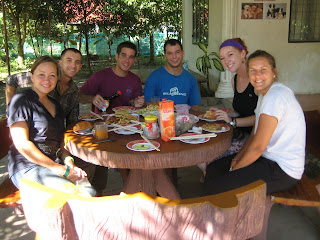
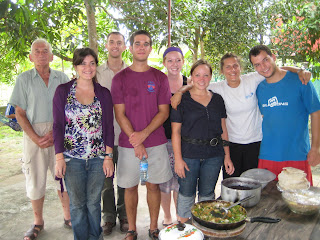
Lunch was Mexican food (very American, I know). Here's us with some of the food:
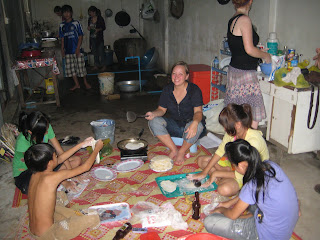
We rolled the tortillas with beer cans.
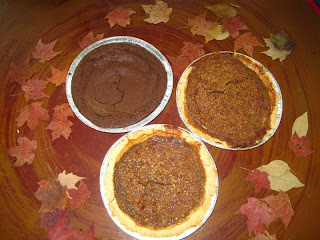
And then we made pies and brownies for dessert in the late afternoon. The leaves were mailed by the family of another volunteer and kept in an envelope.
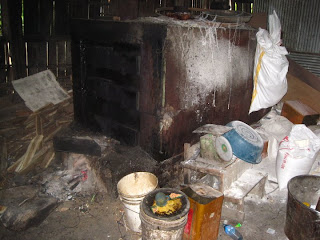
To make the pies and brownies, we went down the street to use a local bread oven. When I asked about the temperature of the oven, the young girl told me it was "hot enough." The high tech oven:
So, which looks more tasty: our American food or traditional Cambodian fish paste (prohok), which I am still mostly unable to eat?

Since they don't celebrate Thanksgiving here, there are no days off for it. So, we celebrated it a bit early. Thanksgiving ingredients are also not easily accessible. And, unlike volunteers in another province, we did not want to go through the trouble of buying our own turkey($12) and killing it ourselves.
By not being traditional about our Thanksgiving, we were able to enhance it. Rather than only enjoying one meal, we cooked and feasted all day and shared our food with my friend's Cambodian host family.
Breakfast included orange juice, a delicious egg scramble and banana pancakes.

Lunch was Mexican food (very American, I know). Here's us with some of the food:

We rolled the tortillas with beer cans.

And then we made pies and brownies for dessert in the late afternoon. The leaves were mailed by the family of another volunteer and kept in an envelope.

To make the pies and brownies, we went down the street to use a local bread oven. When I asked about the temperature of the oven, the young girl told me it was "hot enough." The high tech oven:

So, which looks more tasty: our American food or traditional Cambodian fish paste (prohok), which I am still mostly unable to eat?

Wednesday, November 10, 2010
Drinking during the day
This morning, I went to the countryside with the nurses. They gave out Vitamin A and gave vaccinations and I gave a health presentation.
The nurses giving medicine:

If you look closely at the picture, you can see a shot glass and a container of rice wine next to the medical kit:
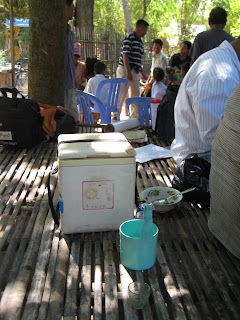
In between repeating the announcement for villagers to bring their children to see the nurses, the village chief would take shots of rice wine with some friends. It was only 10 am at this point. Yet, no one looked twice, as it is not abnormal for a community leader to knock back a few shots in the morning, even while organizing a local event.
To the village chief's credit, he was helpful to me during my presentation. He read some documents I brought and helped me interact with the audience.
While he was behaving poorly by drinking, he was promoting good health during my presentation. I've learned to accept the positive things people can offer me here, even when they do things I would consider unacceptable in America.
The nurses giving medicine:

If you look closely at the picture, you can see a shot glass and a container of rice wine next to the medical kit:

In between repeating the announcement for villagers to bring their children to see the nurses, the village chief would take shots of rice wine with some friends. It was only 10 am at this point. Yet, no one looked twice, as it is not abnormal for a community leader to knock back a few shots in the morning, even while organizing a local event.
To the village chief's credit, he was helpful to me during my presentation. He read some documents I brought and helped me interact with the audience.
While he was behaving poorly by drinking, he was promoting good health during my presentation. I've learned to accept the positive things people can offer me here, even when they do things I would consider unacceptable in America.
Tuesday, November 9, 2010
Have you eaten rice yet?
Last time I spoke about how often I’m asked about my salary and money. This is common for people wanting to get to know me. As for people who already know me or just being friendly, they always ask if I’ve eaten rice yet. I think it’s the most common question in Cambodia. The question actually translates into “have you eaten rice already or not yet?” And then you answer with “already” or “not yet.”
This neighbor asks me every morning if I've eaten rice yet:

The assumption is that eating rice is inevitable. Cambodians typically eat rice almost every meal and when they are not eating rice, they eat noodles or cake made from rice. At a restaurant, the rice has some food on top of it. If they are eating as a family, they have a bowl of rice and a one or two dishes of fish or meat and vegetables in the middle of the table. They assume that westerners do the same thing, but eat bread instead of rice.
Here are my host-brothers having dinner. In the background, other family members are watching TV:

Statistic of the day: 100-400 million. This is the range of guesses of the global population by the students who I taught geography to today.
Subscribe to:
Posts (Atom)