Friday, June 4, 2010

Health Education

A woman cleans a raw chicken and then eats a bowl of rice with her hands. Naked children play in mud and then their parents peel a rambutan (a small, red spiky fruit) and hand it to them to eat. This is the sort of scene I see all the time in Cambodia, where basic hygiene, like washing one’s hands, is not yet common practice. Poor hygiene adds to Cambodia’s disease burden, which includes serious diarrhea and exotic mosquito born-illnesses. The disease burden contributes to the low life expectancy in Cambodia; the average Cambodian born today is expected to live to be 60. That’s why I devote a lot of time to working with Cambodians to encourage better hygiene practices.

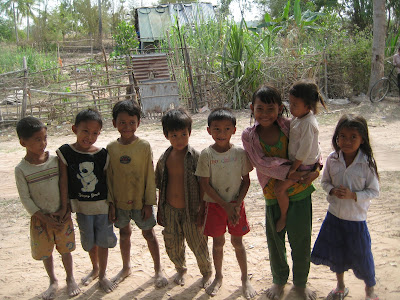
Here is a photo of children in the mud:
From blog 8-10


Behavioral change is a slow process. However, by empowering community members to speak out about health concerns, people can spread proper health practices. I believe this is crucial for Cambodians to take better care of themselves and for Cambodia to continue to develop.

One thing I do is bike around the district with some of my students. We stop when we see groups of people idly chatting by their houses. We then give them a short presentation about hygiene. When they answer questions at the end, we give them candy or toothbrushes. The toothbrushes come from hotels all over Cambodia because I’ve asked other Peace Corps Volunteers to collect complimentary toothbrushes for me.

Here is a picture of a presentation:

From hygiene bike ride july 2010


These students are from my summer English Club. Once a week, we focus on health. While teaching about health, I have the students practice their public-speaking skills to explain the health concepts. I do this because, in addition to practicing poor hygiene, most students slouch and speak quietly and quickly because they are too nervous to speak in public. Therefore, it is satisfying when I see students in front of a group smiling, as they interact with the audience during our health education bike rides.

I was also surprised to learn I’ve opened some of my students’ eyes to community service (Most people I work with are already inclined to it). One of my students told me (in English) when we were biking back one day that he was “happy to participate with me” and that this was his first time doing anything like this. His interest was of particular value to me considering I didn’t even expect him to show up. When I announced the bike rides, he told me he didn’t have a bike (he borrowed one) and he is usually busy tending his cows.

My presence makes health campaigns a memorable experience for the audience since many of the rural villagers have never seen a westerner, let alone one who speaks Khmer (albeit with poor pronunciation).

The information I share is also regarded highly. This was pointed out to me after a morning of giving health presentations in the village with the health center staff (a separate program from my English club). A nurse explained to me over rice and soup that Cambodian people don’t trust information from other Cambodians, but they trust information from a white foreigner (having light skin implies you are wealthier and aren’t out in the fields all day, so Cambodians want light skin). The nurse was exaggerating, as Cambodian people like to do when they compliment you, but there is some truth in what he said. Whenever I am sick, everyone I know gives me medical advice that would result in a lawsuit in America. One of my friends got bitten by a feral cat, and the locally prescribed remedy was to put some Chinese balm on it. Luckily, he chose to call the Peace Corps doctor instead.

The health center outreach usually takes place at a village chief or village health volunteer’s house (the district is divided into communes and villages). These houses serve as a rudimentary health clinic. They provide basic information and distribution of things like water filters, but no medicine or expert consultation. Local health services are essential, since health centers and hospitals can be too far for a poor villager to go. Many villagers live ten miles from a health center and most live 20 from an actual hospital. It is also difficult for a villager to miss a day of rice farming or leave their animals unattended.

The village chief sometimes invites villagers to come to the health outreach with a loudspeaker that can go nearly a half-mile. This is necessary because the villages are so spread out and the nurses only go to each village once every two months. While I like the loudspeakers when they are providing health services, I dislike them when they are used to promote a social event. 4 am announcements for a festival or all-night wedding music are not uncommon, as there are no noise ordinances in Cambodia.

It’s interesting how something as simple as washing hands is institutionalized in a society. In America, we take for granted how easy it is to find a sink, soap and a clean towel, all right next to each other. When I eat lunch at my host-family’s shop, I keep a clean towel in my bag to dry my hands and the place where I wash my hands and where the soap is kept are far apart. I’m the only one in my host-family who washes my hands before meals.

The lack of hand-washing is present in the medical establishment as well. I’ve been to offices staffed by doctors, who are supposed to monitor health in large areas, but lack soap and towels in the bathroom!

Alcohol is also a serious problem in Cambodia. A Cambodian drinking party, which frequently occurs in the middle of the work day, consists of men sitting around a table. The drinks of choice are beer with ice or rice wine that burns as it goes down (Rice wine translates from Khmer to English as white wine and I go through pains trying to explain that we drink white wine made from grapes in America. They find the idea of our white wine revolting, oddly enough). There are usually some peanuts and meat - dog meat is sometimes served at this time. No one takes a sip of their drink unless everyone takes a sip. If anyone is drinking too slow or does not drink when the rest of the group drinks, they are ridiculed and badgered until they drink more, as if they are a college freshman trying to get into the drunkest fraternity. This is the norm; high ranking officials and the poorest farmers drink in this manner regularly regardless of age.

From blog 8-10


While there are radio and TV ads encouraging good hygiene, not much is being done about alcoholism in Cambodia. However, Samon (the teacher I do a lot of projects with) and a group have been spearheading the effort locally, by biking around the village to educate people about alcoholism and having community meetings to discuss it. His group wants to get a law passed so children under 16 cannot buy alcohol (there is currently no law about who can buy alcohol).

Here, we stopped at one of the drinking parties. Usually they are friendly, but sometimes drunk people can be angry or rude as you’d imagine:

From blog june 2010


Some of our group with their bikes and our posters:

From blog june 2010


When we give the presentation, we show pictures of the heart, liver and brain and talk about the effects long-term alcohol use can have:

From blog june 2010


This home-made poster talks about some of the dangers of excessive alcohol use:

From blog june 2010


The top right is a sick person. Many people in the rural areas listen to traditional healers who tell them that alcohol can cure their illnesses. During one presentation, a person was trying to tell us that even though raw toad is poisonous, if you mix it with rice wine, it becomes medicine.

Here I am, explaining some of the pictures:

From blog june 2010


At my English club, I was teaching students how to talk about their daily schedules. One student explained how in the evenings he does housework, watches TV and then has dinner. Another student, who is usually shy, says “You forgot something.” We all wonder what. Then the quiet student explains, “You forgot that you need to wash your hands before you eat dinner.”

From hygiene bike ride july 2010

Saturday, May 8, 2010

Khmer New Year

Khmer New Year usually consists of lots of family time, feasts and dancing. The official holiday is three days long (April 14-16), but school closes for five weeks and there is holiday cheer in the air for at least two weeks leading up to the holiday.

Depending on the occupation and wealth of the family, the holiday can last between one day and a week. For example, farmers, even though they are usually poor, have a lot of time to celebrate the holiday since it is not harvest or planting time. Sellers at the market, like my family, even if they are rich, need to work because business is good during Khmer New Year. And the extremely wealthy can celebrate a long time, while those who are poor do not celebrate much because they do not have enough money.

The holiday requires buying lots of food and drinks and making donations at pagodas or dance sites where people congregate. So, Khmer people spend a lot of money during the holiday. Following the holiday, I asked people if they “were happy on Khmer New Year.” Most people would say yes, but the reason a lot of people said no was because they did not have any money.

As a result of the cost of celebrating, many thefts occur around the holiday because people want money. My family said business was great during Khmer New Year, but afterward, it was not good because people spent all their money.

April 13
The day before Khmer New Year, I went on a bike ride to different pagodas with Samon (a teacher I work with on projects a lot) and some students. The students who attended are a lot of my students who are active in the community. We had planned to play a lot of traditional Khmer games and talk about not drinking too much on the holiday (any time Cambodian people have free time, excessive binge drinking occurs), but we mostly just played games. Many games resembled western games, like duck duck goose, tug of war and tag.

From pre-khmer new year 2010


From pre-khmer new year 2010


This game was my favorite. On one end of an area are two full water bottles and on one end are two empty water bottles. The participants race each other to fill the empty ones. But, they have to transport the water across the area from one water bottle to another in their mouths.

From pre-khmer new year 2010


From pre-khmer new year 2010


From pre-khmer new year 2010


From pre-khmer new year 2010


Cows are always wondering around Cambodia. No big deal, we just chase them away.

From pre-khmer new year 2010


From pre-khmer new year 2010


April 14 (Day 1)
By 10 AM, the festivities had begun. Most of the men in my extended host family got together.

All the men enjoying food and beer. . .

From khmer new year 2010


… while the women cook.

From khmer new year 2010


April 15
The next day, I spent time with Samon and his family. They made Khmer traditional cakes, which are basically rice with either banana or sugar wrapped in a banana leaf. But, the wrapping process is excessively complicated. I couldn’t do it.

From khmer new year 2010


From khmer new year 2010


Then Samon and I went for a walk, stopping at a few small dance parties.

From khmer new year 2010


Khmer children love climbing trees. No one seems concerned about their safety.

From khmer new year 2010


Samon and I with blue tongues after eating the berries that the tree climber gave us.

From khmer new year 2010


April 16 (Day 3 and my birthday)
Khmer people to not celebrate birthdays except for old rich people, so my birthday was uneventful, except for some phone calls from America.

At least there were parties though.

From khmer new year 2010

From khmer new year 2010


One Khmer New Year tradition is to put powder on people. It’s supposedly came about as an excuse so the opposite sex can touch each other for once, but it’s also a way for kids to be cute.
From khmer new year 2010

From khmer new year 2010


April 17 (Day 4?)
Some people continued to celebrate for a few more days, but I was partied out.

Khmer New Year was interesting and I enjoyed going to a lot of different places. I’m also happy to get back to work. In my next post, I’ll talk about some the health education I’ve been doing in the rural villages with the health center staff.

Tuesday, April 27, 2010

Bamboo Train

Over the summer, I rode the bamboo train to a remote village to learn about rural health education. It was raining, so I didn't bring my camera, which I regret. It was especially unfortunate because I did not expect to ride the train again. Luckily, I found an article about the train, which also includes a picture:
http://tinyurl.com/2uv7xqw

(if the link doesn't work, the article is called "End of the line for Cambodia's bamboo trains" from the LA Times)

Notice the 5th paragraph, which is particularly accurate in my case. We were usually the lighter train, so had to get off and take the entire train off the track.

Sunday, April 11, 2010

How lonely and bored am I actually?

There is this notion of Peace Corps Volunteers, out in the middle of the jungle in a straw hut by themselves. They don’t have much to do, so it’s just them on a hammock with a pile of books. Right now, this is sort of my life, only it’s a big cement house and my books are on a shelf. But even now, during the hottest month leading up to Khmer New Year, my life is interesting. And, I’m certainly never bored.

What I’m talking about here is only my personal experience in Cambodia. I am lucky that I have a few coworkers that are fairly committed to teaching and interested in doing projects to help their community. The truth is, it’s hard to projects here if you don’t have Cambodian people who take ownership of the projects. I know one volunteer who lives in a place where no one ever comes to school. He is in a very rural place and some volunteers live in more urban areas, as well.

The way my district is laid out is also to my advantage. My house, the market, the school and the health center are close together. So, I walk everywhere. I’m fairly outgoing and Cambodian people love talking to foreigners, so I spend a lot of time practicing my Khmer and making connections in my community. I’m always learning something new about Khmer culture and it’s still exciting to meet new people.

Typically, between teaching, networking, practicing Khmer and projects, I’m usually kept pretty busy for most of the day, especially by Peace Corps Cambodia standards. On a typical day, I only get to try to make a dent in my shelf full of books for one or two hours.

What about loneliness? You’d think being around people almost all day and being busy would prevent me from being homesick and lonely. Most of the time, this is the case. Some days, I really do miss people though (and food! It’s just not the same, even in Phnom Penh). It’s not only being homesick, but what I like to call being “culture sick.” Since the language and culture are different here, things don’t function as I perceive to be normal. For example, people talk about different things here and handle social interactions differently. It wearss on me sometimes.

There’s also the issue of being pretty much the only foreigner where I live, and even when I go to Phnom Penh I stand out. In my district, people always want to talk to me, which is usually nice, but can occasionally be bothersome. People also tend to think that I have deep pockets since I’m a foreigner. Now that a lot of people know me in my district, this is less of a problem, but I still occasionally have a seller trying to quadruple the price of something that I bought from the same stand for the real price a few days ago. In Phnom Penh, they can’t believe that I could possibly want to walk somewhere. I must want a moto or a tuk tuk (a cart pulled by a motorcycle), so they constantly ask me if I want a ride.

Overall though, loneliness, homesickness and culture sickness have not been a problem. Perhaps the summer could be troublesome if the projects I want to do don’t get off the ground, but during this vacation I have lots of downtime and it’s been great.

As I’ve mentioned, Cambodia gradually shuts down leading up to Khmer New Year (April 14-16). I have not had school in weeks and other things stop as people spend more time with family and relaxing. This is a chance for me to read a lot more. I also spend time with my Cambodian friends. I am invited to celebrations and festivals that families have to honor their ancestors. I also just walk around and chat with my neighbors.

I never eat my meals alone. I eat my breakfast at a variety of food stall and all the sellers know me and we chat, or I meet new people who are also eating there. Then, I eat lunch and dinner with my host-family. They are a bunch of jokers. After lunch the other day, they were telling me that they want my Peace Corps friend from another district to switch places with me because they want another girl in the family. I knew they were joking, but afterward, one of my host-brothers, who I help with English sometimes, made certain to clarify for me: “They don’t really want you to leave; they just want to make you happy after lunch.”

It’s all about being happy in Cambodia. “How are you?” directly translates to “happy?” Two common questions I’m asked if I’m happy when I come to Cambodia and if I miss home. I answer yes to both.

Note: April is also great because it’s mango season! One mango costs between 200 and 500 riel (4-13 cents). I usually eat between two and six a day.

Thursday, March 25, 2010

Weddings

Sorry I haven’t posted in a while. I’ve been really busy with teaching and projects, but now things are slowing down. I have one more big project this weekend, and then there’s pretty much 4-6 weeks of no school for the Khmer New Year (April 14-16). Yes, a three day holiday requires that much time off from school.

Another thing I’ve been busy with is Khmer weddings because it’s wedding season. Wedding season is in the dry season so that they don’t have to worry about rain. I’ll give you a rundown of my co-teacher Sopheap’s weddings.

Sopheap and his fiancee been engaged for almost a year, but they had to wait until wedding season and he had to save up for the dowry. Khmer weddings are a combination of independent courtship and family approval and arrangement. I believe Sopheap met his wife on his own, but their families knew each other.

A few weeks before the wedding, the couple and their relatives give invitations to their friends. But, there is no need to rsvp, just come or don’t come.

Khmer people like going to weddings, but usually money determines if they go. Instead of giving gifts, Khmer people put cash in the invitation envelope and then they have to go to a table where they record how much they give. So, poorer families may have trouble going to all the weddings that they are invited to.

Some Peace Corps Volunteers are bothered by weddings because Khmer people only invite them because they think foreigners have a lot of money. I am lucky that the people who invite me to weddings just want me to be happy there and don’t want me to give money. I always try to give the standard amount, but my Khmer friends always try to drag me away from the table before I can give the money.

Weddings are usually one day, but can sometimes be more. Sopheap’s wedding was one day. Most guests don’t arrive until the evening. The morning involves a lot of pictures and kneeling. During the whole ceremony, the bride and groom change clothes a lot. Here is them in one of their outfits:
From sopheap's wedding


This wedding was particularly fun because a few other Peace Corps Volunteers came and they decided to get traditional Khmer make-up. I thought they looked goofy, but all the Khmer people thought they looked very pretty. The three girls on the right are wearing traditional Khmer make-up:
From sopheap's wedding


When you arrive at a wedding, you are given a seat and have to wait for everyone to be seated at your table before you are given food and drinks. So, it’s good to arrive with your friends.

Here is me with the vice-school director and one of my other co-teachers, Solen (right):
From sopheap's wedding


Here is me with Solen and a biology teacher:
From sopheap's wedding


The food is always really good at weddings and usually involves a few courses. Some wedding tables are tamer than others, but most of the weddings I’ve been at involve a lot of drinking.
From sopheap's wedding


The groom doesn’t drink much, but sometimes he cheers with guests, or the vice school director forces him to drink.
From sopheap's wedding


Then people start dancing. Khmer dancing is mostly a lot of slow, semi-graceful arm-waving and twisting. Men dance with men and women dance with women. For me, it involves a lot of drunk Khmer guys grabbing me and dragging me to the dance floor. Luckily, there is no touching involved in the actual dancing.
From sopheap's wedding


From sopheap's wedding


Weddings sometimes go until about 3am and keep all the neighbors from sleeping, but I left this one a little earlier. Now wedding season is ending and Khmer New Year season is beginning and April looks to be quite hot. I don't think I can write a blog-post about Cambodia without finding somewhere to comment on the heat and April is supposedly the hottest month. Wish me luck.

Friday, February 12, 2010

Test taking in Cambodia

Things have been pretty laid back lately. The students had semester exams, which means I had a few days off. I imagine the reasons I don't have to proctor are a combination of me not being a native Khmer speaker and my strictness on cheating. Many teachers here let cheating slide or help the students cheat for a small fee (maybe 100 riel or $.02 per student is my understanding).

It's also crazy cause even when the students aren't supposed to cheat, they are incredibly bad at hiding it. If any of my students took a test in America, their test would be taken away by the teacher in about 30 seconds. They basically talk to the student next to them, blatantly look at a cheat sheet or blatantly copy the student next to them. Despite cheating, the students still get lots of answers wrong.

There is also a complete lack of study skills. Students don't really study that hard or know how to study. Many students will actually come into a test knowing nothing and just copy someone else.

The teachers are partly responsible for this. Students aren't told about a test until a day before and sometimes are not informed in advance at all. Teachers will put material on the test that hasn't been covered or even material they themselves don't know. Following the grade 10 English midterm, I had to help the teachers get the correct answer for the test that they made.

I try to do what I can to help, but the truth is, I'm not in a position to make any real difference with test taking here. When people I work with want to take on cheating and teach the students study skills, I help and advise them, but I can't do anything about it by myself.

The reality of being a Peace Corps Volunteer is that you see problems all around you, but you cannot make a sustainable difference unless native people want to solve the problems. So, I basically figure out what Cambodians want to work on and help them do it. I always mention ideas I have and try to educate people, but large scale campaigns on many issues like cheating just don't have the support. Maybe in the future I'll do a study skills workshop if my Cambodian friends want to do it with me.

A project that has gained support are the seminars Samon (a fellow teacher) and I are doing. We just hosted a leadership seminar and the school director came and spoke about leadership and the challenges he overcame. He talked about his values and how he worked hard and survived the Khmer Rouge to get where he is today. When he went to high school, he had to walk 15km (9 miles) each way, over two mountains and through the forest. Here are some pictures of the workshop:

Samon and I.
From leadership and walk


The school director.
From leadership and walk


I also have done some educating about hygiene lately. I spoke with the savings group I'm working with about hand-washing and Samon spoke with them about the importance of using a toilet. Apparently, many people have latrines, but prefer not to use them.

Onto something a little more enticing: food. Here is a picture of my breakfast the other day, the Khmer version of soup and a sandwich.

From leadership and walk


The bowl is full of Khmer porridge, which is basically rice, veggies and fish. On the right is a sandwich. In the sandwich are vegetables and meat (with the consistency of tofu), something with the texture of sauerkraut and soy sauce and hot sauce. Don't let my description fool you; it's actually delicious (though it's also possible my sandwich standards have lowered here). And yes, it is wrapped in a rubber band and a piece of copy paper. Sometimes the paper has writing on it, but not today.

This next shot is a picture of my friends at the stand where I got the food. They are very friendly people, like most Khmer people.

From leadership and walk


Here are some pictures of a few of my students. My students are also friendly and cheerful and many of them want to learn English, despite their massive amounts of cheating.

From leadership and walk

From leadership and walk


And this is someone I met when I was walking around. He's fishing in a small canal.

From leadership and walk


Next week, I have a week of Peace Corps training in Phnom Penh. Although things are going well here, it will be nice to have a break.

Saturday, January 23, 2010

Some New Photos

Here are a few more pictures. There’s a lot here, so please ask me questions.

The second public speaking workshop went quite well. The students learned how to write a speech and watched Obama and MLK. We explained the significance and profound impact of MLK and had the students work in groups to make and present their own speeches about their dreams.

Here’s a student introducing himself to the group:

From public speaking 1-21-10


Here are some of the students working in groups to make the dream speeches:

From public speaking 1-21-10


On Sunday, I joined a march with students and teachers, organized by a local NGO. The purpose was to encourage parents to keep their children in school. Girls are sometimes pulled out of school earlier than boys, so we also tried to promote keeping girls in school as long as boys. Taking on these issues presents a variety of daunting challenges, but the march itself was inspiring and fun. The march was 6km and many of the Khmer people were very tired after. I took some pictures of the march and some pictures of the scenery.

From 1-17-10 mostly march


From 1-17-10 mostly march


From 1-17-10 mostly march


After the march, there were some light refreshments. This is me racing one of my students to eat a banana.

From 1-17-10 mostly march


I got pretty competitive and then thought I won, but I think he beat me by a second.

From 1-17-10 mostly march


On the way to the walk, I took some pictures of my neighborhood.

This is the road by my house.

From 1-17-10 mostly march


This is the shop my host family owns and works at. The left is a pharmacy. The right has a clothing shop and a place to exchange money (dollars, Khmer currency and Vietnamese currency since we are close to the border)

From 1-17-10 mostly march


These are some of my neighbors who I chat with a lot.

From 1-17-10 mostly march


(Khmer people usually don’t smile for pictures)

From 1-17-10 mostly march


From 1-17-10 mostly march


From 1-17-10 mostly march